
Fast Enough for You 🎸: Waiting in the Shallows: Emotional Unavailability, the Fear of Not Being Enough, and What It Costs the People Who Wait
Key Concepts in This Post:
The “if only” reflex: how mental illness builds a conditional version of yourself that never quite arrives 💭
Emotional burden accumulates quietly, and the people who love us carry more of it than we usually realize 🪨
Waiting in the shallows is not the same as abandoning someone. It is also not the same as being present. 🌊
Recovery moves at its own pace, and that pace rarely matches what the people we love actually need 💧
Staying in the room after you know you’re not fast enough. That is where the real work begins 🌱
Phish is not a band you go to for quiet. They are four musicians who built a shared language so specific, so private between them, that no one else can really speak it. I have been hearing it for thirty years, since a cassette tape in 1995 taught me the catalog before I ever saw them live. I fell in love in private first. That is the way it works with Phish, if it works for you at all. You find them alone. You carry them a while before you understand what you have.
“Fast Enough for You” found me the same way.
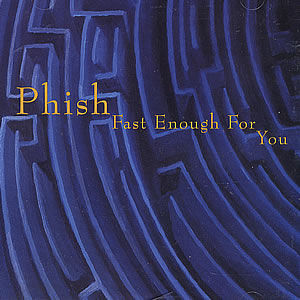
It is Track 2 on Rift, their 1993 concept album, and it is the outlier in a catalog full of outliers. Phish jams. Phish sprawls. Phish builds a room in a song and then spends forty-five minutes rearranging the furniture until the room becomes something else entirely. “Fast Enough for You” is none of that. It is sixteen lines long. There is no jam. There is no build. There is a pedal steel guitar, played by the late Vermont musician Gordon Stone, and Trey Anastasio’s voice, and sixteen lines from Tom Marshall that cut so clean you almost do not notice how deep they go until afterward.
I noticed, eventually. It took the right years to arrive.
Those years were what I would call the quiet damage period. Not dramatic, not a crisis you could name from the outside, just the slow erosion of being someone who loves his family deeply and is, with some consistency, unable to show up the way that love deserves. Donna was patient in ways I had not earned. The kids needed a version of their father I was not always able to produce. I was there, technically. I was trying, genuinely. The question the song asks is whether trying is the same thing as enough.
That question has never really left me. When Trey delivers the song’s central line, he does not make it an accusation. He makes it a confession. That confession, sixteen lines and no resolution, ends the same way it began.
Some History For You 📚
Rift was Phish’s fourth studio album, released in February 1993, and it is their most nakedly emotional studio statement. Tom Marshall, who writes the words while Trey composes the music, has said he wrote much of the album during a period of genuine uncertainty in his own relationships. He wrote it, Trey told him later, “to get the darkness out of your system so that it wouldn’t come true.” Marshall’s response has been that “it’s much easier for me to write when the abyss beckons.” Some of the best writing in the Phish catalog happened because Tom Marshall let the darkness speak and then let Trey turn it into music.
“Fast Enough for You” arrives right away, immediately after the title track establishes the album’s dreaming framework. The record is a concept album: a night of troubled sleep, a relationship examined through the logic of dreams. “Rift” opens the album and names the fracture. “Fast Enough for You” is where the dream turns inward: not a scene, not an argument, just a man alone with the knowledge that his pace, his capacity, his way of moving through love is not adequate. The rest of the album spirals outward from this admission. The song is the wound, stated plainly, before the dream distorts it into everything that follows.
The pedal steel guitar on the recording belongs to Gordon Stone, a Vermont musician who brought the same instrument to the song’s live debut on November 19, 1992. Gordon passed away in July 2020, just as the pandemic summer was reaching some of its darkest moments. His sound is all over this recording, and his absence is worth naming. The song would not sound like itself without him.
“Fast Enough for You” is a genuine rarity in the live catalog, appearing in roughly one of every twenty-six Phish shows. When it surfaces, it tends to carry weight. There is a version from January 4, 2003, in Hampton, Virginia, frequently cited for the particular emotional honesty of Trey’s delivery. There is the 2009 reunion-era version in Asheville, North Carolina, the first performance after the band’s hiatus and Trey’s addiction and recovery, that reportedly stopped people cold. A song this honest requires a particular kind of readiness to sing it and Phish seems to know that.
The Lyrical Links 🔗
Here is where the song earns its place on this blog. These are the lines that really resonated with me and what I think they are really saying about mental health.
💭 “If time were only part of the equation / Then you could draw the boundaries of our cage”
Theme: The Conditional Self. The “If Only” That Mental Illness Keeps On Cashing.
Those two lines contain an entire psychology of avoidance. The narrator is not lying. He genuinely believes that things would be different if the conditions were different: if time were reorganized, if the pressure were rearranged, if the cage had different dimensions. He is constructing a version of himself, a conditional self, who would be more present, more available, more capable if only the circumstances cooperated.
This is one of the quietest and most insidious things that depression and bipolar disorder do inside a relationship. They produce this exact construction: I would be a better husband if I were not managing an episode. I would be a better father if my mood were stable. I would show up the way I know I should if the conditions were slightly different. The conditional self is the self that never quite arrives, because the conditions are never quite right, because the conditions are not actually the problem.
The word “cage” is a carefully chosen one. The narrator is not blaming his partner. The cage is the relationship itself, the structure of expectation and time and commitment. He is stuck inside it with her. They both are. He cannot get out. The cage is love, and he is too depleted to inhabit it the way it deserves.
🪨 “You wouldn’t pile another stone upon me / And I’d be happy just to watch you age”
Theme: The Slow Weight. What It Costs to Be Loved When Your Capacity Is Empty.
There is grief in these two lines and there is tenderness, and somehow they coexist. The first line is about burden: not one dramatic demand, not a fight, but the slow accumulation of unmet needs felt as something physical. Every reasonable expectation the person you love has of you, when your internal resources are depleted, can register as weight added to weight. The narrator is not saying his partner is unreasonable. He is saying that reasonable needs, when you have nothing left to give, land like stones.
“And I’d be happy just to watch you age” is the most tender line in a Phish song I have ever heard. Stripped of pressure, stripped of the weight, this is what love looks like to the narrator: quiet, patient, sufficient. He does not need grandeur. He does not need to be remarkable. He needs enough breathing room to love her in the only way he knows how, which is steady and present and real, even when it is not enough.
I have felt this, and not as an excuse. This is an honest account of the experience. There are cycles, for anyone managing bipolar disorder, when love is not the problem and presence is not the problem and the relationship is not the problem. The depletion is the problem. Donna has lived with that reality alongside me, and she did not sign up for it. The longing in this lyric is real. It is the self that wants to be there, even on the days it cannot show up.
🌊 “But everything is in its own dominion / And waiting in the shallows as I do”
Theme: The Shallows. Present in Body, Elsewhere in Everything That Matters.
“Everything is in its own dominion” is another way of saying: I have learned to keep things separate. My internal life is one territory. My relationship is another. My work is another. They are contained, managed, and not allowed to bleed into each other. This is called compartmentalization, and it is a survival strategy before it is a wall. The survival strategy becomes the wall at some point, usually before you notice it happening, and the person on the other side of it is wondering why you are so difficult to actually reach.
The image of waiting in the shallows is such an honest picture of emotional unavailability. The shallows are safe. You can see the bottom. You do not have to swim. You are not drowning. You are not missing. You are just hovering there, at the edge of the depth, while the person who loves you stands on the shore and watches you not come any closer.
I spent time in the shallows. More time than I have fully reckoned with. Present enough to avoid the conversation, absent enough to not really be there for it. Reese was growing up during some of those years. Dylan too, in the earlier stretch. I was in the room. I was not always in the room. The shallows feel safer than the deep water. They are also not where the people you love need you to be.
💧 “Appeases me as water slowly trickles out / Which isn’t nearly fast enough for you”
Theme: The Mismatch of Pace. Recovery Is Slow, and Slow Is Not What Anyone Ordered.
The narrator is not withholding. He is not choosing to move at the speed he moves. He is moving at the speed he can move, and that speed (water trickling, not flowing, not rushing) does not match what his partner needs. He cannot change the physics of it. The trickle appeases him because the trickle is all he has access to. The trickle is not nearly fast enough for her, and he knows it, and the knowing does not change the physics either.
Recovery is slow. Healing is not linear. The people who love us while we are in the process of getting better are often waiting, sometimes patiently and sometimes not, for us to catch up to who they need us to be. There is nothing villainous about that waiting. It is exhausting, and it is real, and Donna has done it. The compassion available in these lyrics runs in both directions: the pain of not being enough, and an honest acknowledgment of what a partner carries when the person they love is moving at the speed of a trickle.
This is not a song that asks you to forgive the narrator. It asks you to understand the physics. The water moves at its own speed. The mismatch is not malice. The mismatch is the illness, and the illness is not the same thing as the person, and the person is still trying even when the trying does not show.
😔 “It’s what I was afraid of / I stumble into view”
Theme: Anticipated Failure. When the Dread Turns Out to Have Been Right All Along.
“It’s what I was afraid of” may be the most devastating line in the song. The narrator knew. He always knew that his capacity would not be sufficient. The fear was not irrational anxiety projecting catastrophe onto an innocent future. The fear was accurate self-knowledge, and it came true anyway, and he is standing in the wreckage of a thing he saw coming and could not prevent.
Anxiety at its cruelest is this: when the dread is justified. This is not the spiral that manufactures disaster from nothing, but the quiet, grinding certainty that arrives because you know yourself, and what you know is that you are going to fall short in the place that matters most. Living with that knowledge, getting up every morning and going toward the relationship anyway, is an act of some courage. The song does not name it as courage. It names it as stumbling: “I stumble into view,” not a dramatic entrance but an accidental one. He did not choose to arrive at this moment. He fell into it.
I know the stumble: the pre-emptive apologies, the bracing for the moment the people you love realize you are not who they needed, the particular grief of fears that come true. The song does not resolve this. What it offers instead is the next line: he is still there. He stumbled into view. He did not disappear. That, on the hardest days, is sometimes the whole victory.
🔁 “But it isn’t nearly fast enough for you / It isn’t nearly fast enough for you”
Theme: The Loop. What Shame Sounds Like When the Room Is Quiet.
The song ends the same way it started. There is no resolution, no catharsis, no earned moment of peace or declared intention to do better. The narrator returns to the same admission, says it again, and the song closes. This structural choice is one of the most honest things Phish ever committed to a studio recording.
This is what rumination sounds like. This is what the shame loop sounds like at three in the morning: returning again and again to the same evidence of your own inadequacy, not to learn from it but to circle it, unable to land. The mind at its least generous toward itself does not escalate into drama. It loops. It repeats. It sits in the same truth and will not let you move on.
The power of the song ending without resolution is that it refuses to pretend. Phish could have added a hopeful turn. They did not. Sometimes there is no resolution. Sometimes you sit in the knowledge that you were not enough today, that the trickle was not sufficient, that your partner needed you to be faster and you could not manage it. The thing you do next, after you sit in that, is get up tomorrow and try again. That is what recovery actually looks like. It is not a crescendo. It is a loop that you interrupt, one day at a time, by being slightly more present than you were the day before.
What This Song Did for Me 🎸
Trey Anastasio has been singing this song since 1992. He sang it through the years he was struggling, through the addiction that had taken hold by 2000, through the arrest in December 2006, through recovery, through reunion. He sang it as a person who had been the narrator, who had failed the people around him in the specific ways the song describes, who had come back from a version of the same abyss. He has been sober since 2007. He built a residential recovery center in Vermont. He is still playing. He is still, now and then, singing this song.
I think about what it means to sing a song for thirty years that is this honest about your own limitations. You cannot perform it at a distance. You have to keep returning to the truth of it, keep being willing to stand inside “it’s what I was afraid of” and not flinch. That takes something. I do not fully have it yet. I am working toward it.
Gordon Stone, who played the pedal steel on the original recording and on the song’s debut in 1992, passed away in July 2020. That was the same summer I found myself not wanting to exist anymore, the same summer I was sitting with a picture of Dylan on a river trip, looking out at the world, while I was behind the camera falling apart. I did not know Stone had died at the time. I learned it later and felt the particular sadness of losing a sound you did not know you were attached to. That summer was full of that kind of loss. If any part of this resonates with something you are carrying right now, please know that help is available. The Suicide and Crisis Lifeline is free, confidential, and reachable any time by calling or texting 988. The Crisis Text Line is available by texting HOME to 741741. You do not have to carry this alone.
I am still here. My family is still here. The song is still in the catalog, turning up once every twenty-six shows, carrying its weight. What I know now that I did not know during the quiet damage years, is that the question the song asks is not about speed. The question is whether you are willing to be honest about your limits and still show up inside of them. You show up honestly, imperfectly, still trying. That willingness is the whole thing. Phish has been singing it for thirty years. I am trying to live it.
Your Takeaway This Week ✏️
Two honest questions to sit with. No pressure, no grade.
Is there an “if only” you have been living inside, a condition you keep setting before you are willing to fully show up? What would it look like to step out of that condition and just be there, as you actually are, today?
Are you in the shallows with someone who needs you closer to the deep water? Not all the way out. Just closer. What is one step you could take this week toward them?
“Waiting in the shallows as I do” does not have to be the permanent address. It is just where you are right now. The person on the shore is still there.
Take gentle care of yourselves and of each other.
Keep going,
Blake


Comments